

Exodus 32:1-20 - Crushed Covenant

The most dangerous thing we can do is worship according to our own desires.
SINCE WE LAST LEFT OFF... Exodus 25–31
For forty days Moses had been on the mountain with the LORD, receiving detailed instructions for the tabernacle that showed God intended to dwell among His redeemed people on His holy terms.
Exodus 32:1–20 (NIV)
32 When the people saw that Moses was so long in coming down from the mountain, they gathered around Aaron and said, “Come, make us gods who will go before us. As for this fellow Moses who brought us up out of Egypt, we don’t know what has happened to him.”
2 Aaron answered them, “Take off the gold earrings that your wives, your sons and your daughters are wearing, and bring them to me.” 3 So all the people took off their earrings and brought them to Aaron. 4 He took what they handed him and made it into an idol cast in the shape of a calf, fashioning it with a tool. Then they said, “These are your gods, Israel, who brought you up out of Egypt.”
5 When Aaron saw this, he built an altar in front of the calf and announced, “Tomorrow there will be a festival to the LORD.” 6 So the next day the people rose early and sacrificed burnt offerings and presented fellowship offerings. Afterward they sat down to eat and drink and got up to indulge in revelry.
7 Then the LORD said to Moses, “Go down, because your people, whom you brought up out of Egypt, have become corrupt. 8 They have been quick to turn away from what I commanded them and have made themselves an idol cast in the shape of a calf. They have bowed down to it and sacrificed to it and have said, ‘These are your gods, Israel, who brought you up out of Egypt.’
9 “I have seen these people,” the LORD said to Moses, “and they are a stiff-necked people. 10 Now leave me alone so that my anger may burn against them and that I may destroy them. Then I will make you into a great nation.”
11 But Moses sought the favor of the LORD his God. “LORD,” he said, “why should your anger burn against your people, whom you brought out of Egypt with great power and a mighty hand? 12 Why should the Egyptians say, ‘It was with evil intent that he brought them out, to kill them in the mountains and to wipe them off the face of the earth’? Turn from your fierce anger; relent and do not bring disaster on your people.
13 Remember your servants Abraham, Isaac and Israel, to whom you swore by your own self: ‘I will make your descendants as numerous as the stars in the sky and I will give your descendants all this land I promised them, and it will be their inheritance forever.’ ”
14 Then the LORD relented and did not bring on his people the disaster he had threatened.
15 Moses turned and went down the mountain with the two tablets of the covenant law in his hands. They were inscribed on both sides, front and back. 16 The tablets were the work of God; the writing was the writing of God, engraved on the tablets.
17 When Joshua heard the noise of the people shouting, he said to Moses, “There is the sound of war in the camp.”
18 Moses replied:
“It is not the sound of victory,
it is not the sound of defeat;
it is the sound of singing that I hear.”
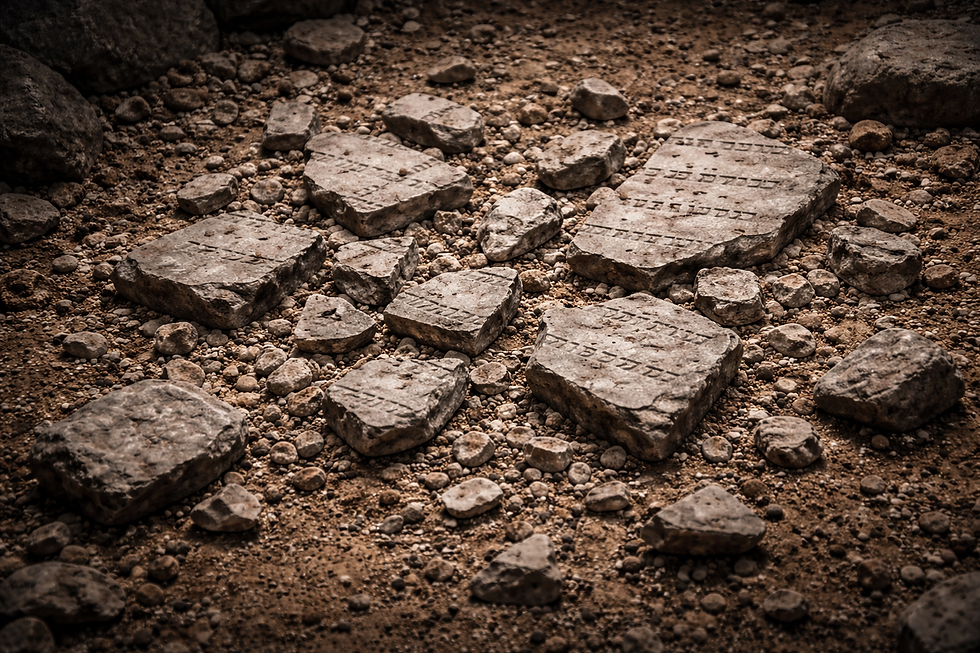
19 When Moses approached the camp and saw the calf and the dancing, his anger burned and he threw the tablets out of his hands, breaking them to pieces at the foot of the mountain. 20 And he took the calf the people had made and burned it in the fire; then he ground it to powder, scattered it on the water and made the Israelites drink it.
Q&A 96
Q. What is God’s will for us
in the second commandment?
A. That we in no way make any image of God
nor worship him in any other way
than he has commanded in his Word.
Summary
Forty days. That's all it took for the people to give up on God. These people, who'd seen the ten plagues devastate the mightiest empire on earth, who'd seen the Red Sea open up so they could escape, who'd heard God's voice thunder down from Sinai, who'd tasted the manna and quail God had provided and drank the water He caused to spring up out of a rock, didn't know what had happened to this fellow Moses, so they assumed that both Moses and the LORD had ditched them.
Aaron was quick to offer a solution, telling the people to fork over their gold jewelry - the same gold God had caused the Egyptians to hand over to them. From this, Aaron forged a golden calf, just like the religious icons their neighbors used to symbolize their gods' power and fertility - power that could be domesticated like a mighty ox.
Aaron confirms that the calf wasn't meant to replace the LORD, but to merely repackage Him. Some of the Israelites immediately referred to the calf as their gods who'd brought them up out of Egypt, but Aaron did his best to redirect their efforts into a festival to the LORD, whose image they had now created and harnessed.
Once the requisite sacrifices had been quickly offered, they sat down to eat and drink and got up to indulge in revelry. The King James and other versions translate this a bit more euphemistically: they rose up to play. Anytime religion deviates from God's truth, it doesn't take long before it takes on sexual elements.
Dig Deeper
The massive irony to this account is its setting. Moses is on the mountain with the LORD, being given the exact instructions for how the people are to worship Him, while the very people who'd been rescued to worship were drunkenly prancing around a gilded calf playing with each other. It's no wonder the LORD's anger burned against them and that He wanted to destroy them.
But God's sinful people had a mediator - one who stood between them and Him. Moses clung to the the covenant promises that God had made as he implored for the rebellious Hebrews he represented. And then once again, we have to work through the difficult language describing how God relented (alternate translation: repented). We don't have the space to dig into that today, but you can go back to Genesis 6 for a brief explanation.
What follows is one of the saddest events in scripture. Moses went back down the mountain with the two tablets of the covenant law in his hands - the work of God; the writing was the writing of God, engraved on the tablets. These tablets - one copy for the people, the other for God, to be kept in the Holy of Holies - documented and sealed God's covenant relationship with the people.
As Moses saw the calf and the dancing, his anger burned and he threw the tablets out of his hands, breaking them to pieces at the foot of the mountain. It wasn't just that Moses' fierce temper got the best of him again, but that he realized that his people had already broken their brand new agreement with the LORD. Sinful humanity is totally incapable of ever keeping it.
God's people would not just need a new and better Mediator than Moses, they'd need a whole new covenant. We find both in Christ (Hebrews 8).
ACKNOWLEDGE WHO GOD IS: Our covenant God and Father, whom we must not worship in any other way than he has commanded in his Word;
ALIGN YOUR LIFE WITH GOD'S WILL: Confess how it is that you forge God into your own image and pray that you will cling to your new and better Mediator, Jesus Christ for salvation;
ASK GOD FOR WHAT YOU NEED:


Comments