

Leviticus 16:1-10 - Scapegoat

Your salvation can be explained by two goats.
SINCE WE LAST LEFT OFF... After the account of Aaron's sons offering 'strange' fire to the LORD and losing their lives, the intervening chapters are filled with regulations meant to protect public health for this community in the wilderness.
Leviticus 16:1–10 (NIV)
16 The LORD spoke to Moses after the death of the two sons of Aaron who died when they approached the LORD. 2 The LORD said to Moses: “Tell your brother Aaron that he is not to come whenever he chooses into the Most Holy Place behind the curtain in front of the atonement cover on the ark, or else he will die. For I will appear in the cloud over the atonement cover.
3 “This is how Aaron is to enter the Most Holy Place: He must first bring a young bull for a sin offering and a ram for a burnt offering. 4 He is to put on the sacred linen tunic, with linen undergarments next to his body; he is to tie the linen sash around him and put on the linen turban. These are sacred garments; so he must bathe himself with water before he puts them on. 5 From the Israelite community he is to take two male goats for a sin offering and a ram for a burnt offering.
6 “Aaron is to offer the bull for his own sin offering to make atonement for himself and his household. 7 Then he is to take the two goats and present them before the LORD at the entrance to the tent of meeting. 8 He is to cast lots for the two goats—one lot for the LORD and the other for the scapegoat. 9 Aaron shall bring the goat whose lot falls to the LORD and sacrifice it for a sin offering. 10 But the goat chosen by lot as the scapegoat shall be presented alive before the LORD to be used for making atonement by sending it into the wilderness as a scapegoat.
--
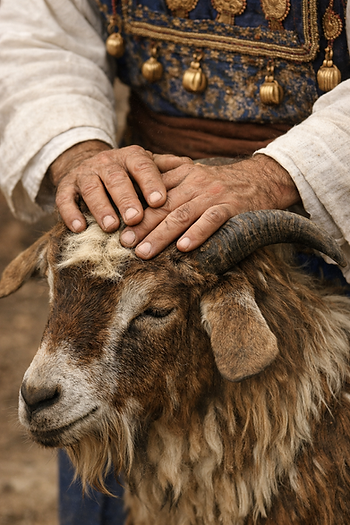
21 He is to lay both hands on the head of the live goat and confess over it all the wickedness and rebellion of the Israelites—all their sins—and put them on the goat’s head. He shall send the goat away into the wilderness in the care of someone appointed for the task. 22 The goat will carry on itself all their sins to a remote place; and the man shall release it in the wilderness.
--
34 “This is to be a lasting ordinance for you: Atonement is to be made once a year for all the sins of the Israelites.”
And it was done, as the LORD commanded Moses.
The Second Main Point of Doctrine
Christ’s Death and Human Redemption Through It
Article 1:
God is not only supremely merciful, but also supremely just. His justice
requires (as he has revealed himself in the Word) that the sins we have
committed against his infinite majesty be punished with both temporal
and eternal punishments, of soul as well as body. We cannot escape these
punishments unless satisfaction is given to God’s justice.
Article 2:
Since, however, we ourselves cannot give this satisfaction or deliver
ourselves from God’s anger, God in his boundless mercy has given us as a
guarantee his only begotten Son, who was made to be sin and a curse for
us, in our place, on the cross, in order that he might give satisfaction for us.
Summary
Even though there are five chapters between the death of Aaron's sons and today's passage, the events we read about today happened right after Nadab and Abihu were consumed by fire from the LORD for worshipping Him differently than the LORD had commanded. So it makes sense that today's passage begins with a warning from the LORD: Tell Aaron not to come whenever he chooses into the Most Holy Place... or else he will die.
Leviticus is so quickly skipped over by many Christians because of it's tedious content - paragraph after long paragraph detailing every facet of how God's people were to live. What gets missed when we skip over Leviticus, however, is that all of these rules and regulations were tied to holiness. Israel was to look, act, eat, and even groom themselves differently because they were God's holy people - a word that means different, literally, cut apart from the rest of the world.
But no amount of rule keeping would be sufficient. None of the people - even the holiest of them - could enter in to the direct presence of the LORD, who appeared in the cloud over the atonement cover of the Ark of the Covenant (other translations render the term atonement cover as mercy seat). Though God dwelled amongst His people, His holiness kept Him separated from them, except for this one day a year, which in Hebrew is called Yom Kippur, translated as the Day of Atonement.
The LORD gave very specific instructions for when and how this meeting could take place (we only read the first 10 verses; the chapter goes on for 24 more verses with these details). The chapter ends with these succinct words: And it was done, as the LORD commanded. After seeing what had happened to his sons, Aaron had very good incentive to make sure he covered ever step and added nothing of his own creation.
Dig Deeper
All of this seems so odd to us as we read it from our side of the cross. Because we've been justified, we not only have peace with God, but we've gained access to Him (Romans 5:1). We can come into God's presence - our Father's presence - any time we'd like! In fact, we're not just invited to do so, but we're commanded to do so, especially as He calls us into His house to worship Him on the LORD's day.
So it's good to be reminded in books like Leviticus of the holiness that being in God's presence requires, and how impossibly unattainable that holiness is for us on our own. But it's even better to have the all important concept of atonement pictured for us by two goats.
One of the goats would serve as a payment, which is what the word atonement ultimately means, and it would make that payment with it's life. It was to make the payment for sin - sin the goat itself was innocent of - as it was sacrificed for a sin offering. The other goat - the scapegoat - was to be used for making atonement by sending it into the wilderness. Aaron was to lay his hands upon the live goat and confess over it all the sins of Israel and put them on the goat's head. He shall then send the goat - carrying the people's sins as their substitute - into the wilderness.
The work of both of these goats was fulfilled by our Savior, Jesus Christ. He is your substitute, having taken on all of your sin. He atoned for that sin with His precious blood, and then took that sin away from you as far as the east is from the west (Psalm 103) so that you would be made holy - able to be in the presence of our God and Father.
ACKNOWLEDGE WHO GOD IS: Our Father, the LORD, who is holy;
ALIGN YOUR LIFE WITH GOD'S WILL: Pray that you better understand the cost required to make you holy;
ASK GOD FOR WHAT YOU NEED:


The American church has done such harm to holy worship. As the atonement paid by Christ for our sins makes way for us to enter His house may we never get bored with God's way to worship, nor seek out churchtainment as some substitute. This lesson from Leviticus is a good reminder.