

Acts 13:1–12 - Christ's Eclectic Church

God expects all Christians to be both a disciple and a discipler.
SINCE WE LAST LEFT OFF... Luke wraps his account of Peter's ministry, telling of how an angel miraculously sprung Peter from prison the night before he was to stand trial before Herod, and of Herod's subsequent sudden pride-fueled death. For the remainder of the book of Acts, Luke's focus will be on Paul's ministry.
Acts 13:1–5 (NASB95)
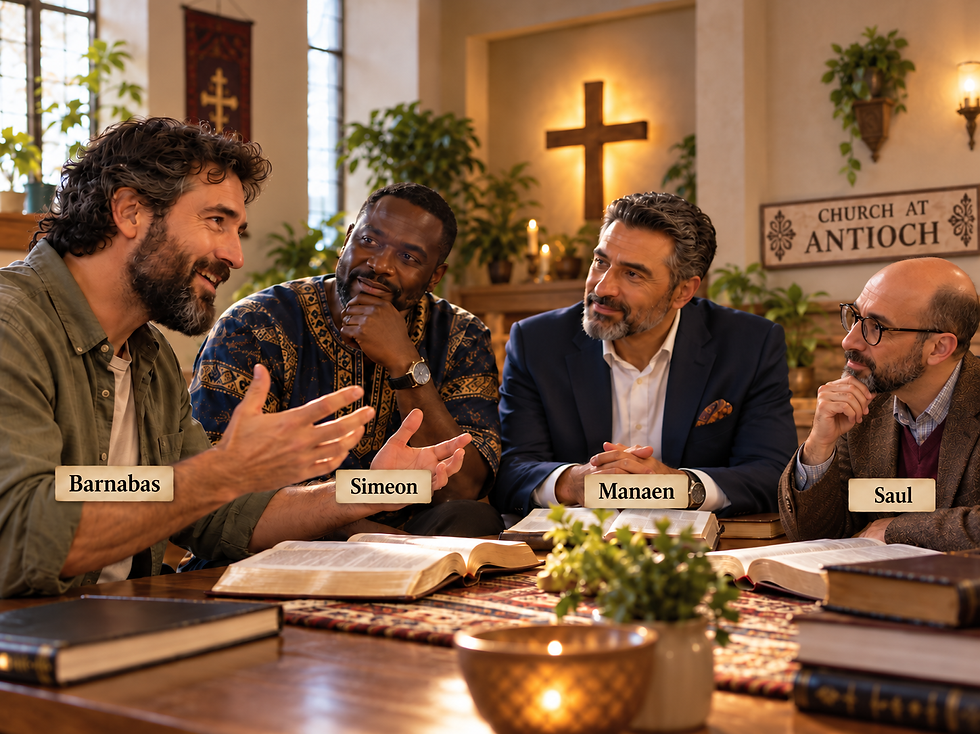
1 Now there were at Antioch, in the church that was there, prophets and teachers: Barnabas, and Simeon who was called Niger, and Lucius of Cyrene, and Manaen who had been brought up with Herod the tetrarch, and Saul. 2 While they were ministering to the Lord and fasting, the Holy Spirit said, “Set apart for Me Barnabas and Saul for the work to which I have called them.” 3 Then, when they had fasted and prayed and laid their hands on them, they sent them away.
4 So, being sent out by the Holy Spirit, they went down to Seleucia and from there they sailed to Cyprus. 5 When they reached Salamis, they began to proclaim the word of God in the synagogues of the Jews; and they also had John [Mark] as their helper.
Belgic Confession
Article 27: The Holy Catholic Church
We believe and confess
one single catholic or universal church—
a holy congregation and gathering
of true Christian believers,
awaiting their entire salvation in Jesus Christ
being washed by his blood,
and sanctified and sealed by the Holy Spirit.
This church has existed from the beginning of the world
and will last until the end,
as appears from the fact
that Christ is eternal King
who cannot be without subjects.
And this holy church is preserved by God
against the rage of the whole world,
even though for a time
it may appear very small
in the eyes of men—
as though it were snuffed out.
For example,
during the very dangerous time of Ahab
the Lord preserved for himself seven thousand men
who did not bend their knees to Baal.
And so this holy church
is not confined,
bound,
or limited to a certain place or certain persons.
But it is spread and dispersed
throughout the entire world,
though still joined and united
in heart and will,
in one and the same Spirit,
by the power of faith.
Summary
Last week we were introduced to the church in Antioch, the community in which the disciples were first called Christians. Luke begins his narration of Paul's missionary journeys with a bit of a deeper look inside this early church.
He begins by introducing us to some of its key leaders. At this point in church history, the concept of ordained church offices that we're familiar with, such as pastor, elder and deacon, really haven't been fully flushed out yet (although we did get some insight into the early stages of what God expects of deacons a couple of weeks ago in chapter six).
Here, Luke simply refers to these leaders as being prophets and teachers, which happen to correspond nicely with what is expected from from church elders. But elders are not the only church members expected to speak prophetically - that is, to proclaim the word of God - and to teach.
In one way or another, all Christians must prophets and teachers. All of us - everyone from seasoned elders to new Christians - are expected to simultaneously be disciples - a word that literally means learner - and teachers. The more you learn from those ahead of you in the faith, the more you can teach those coming behind.
Dig Deeper
What an interesting cast of characters, these prophets and teachers in the church that was there in Antioch:
Barnabas - a man who we first read about way back at the end of chapter four, who owned a tract of land, sold it and brought the money and laid it at the apostles’ feet. His given name was Joseph, but over time he was given this nickname which means Son of Encouragement).
Simeon, who was called Niger - His Latin surname suggests he was from Africa;
Lucius of Cyrene - A city settled by Greek settlers in North Africa, a long way away from Antioch;
Manaen - we really don't know much about him, except for what Luke tells us here in that he had been brought up with Herod the tetrarch. But that clue suggests that Manaen came from a very wealthy and privileged background;
Saul - the persecutor turned preacher. Saul had been a rising star in the Jewish establishment before being dramatically commandeered by Christ. He had been educated at some of the highest academic levels.
I dare you to find something in common between these four men! What an eclectic group the Lord gathered in this early church! If it wasn't for this church in Antioch, these four guys would have certainly never had anything to do with one another!
We live in a society which places a high value on diversity. This is a good thing in and of itself, but even good things can often become problematic. When diversity becomes the primary goal in the church, diversity becomes its primary focus. And ironically, quite often churches that have made diversity their goal often never really become very diverse.
However, when knowing Christ is a church's primary goal, like what it was here in Antioch, where Luke twice describes them as ministering to the Lord, fasting and praying, then diversity often is the ordinary result.
So surround yourself with godly people, even if those people happen to be very different from you, and keep yourself busy coming to know Christ and doing the work to which the Holy Spirit has called you.
ACKNOWLEDGE WHO GOD IS: Our Father, who gathers His people from every nation, tribe, people and language (Rev. 7:9);
ALIGN YOUR LIFE WITH GOD'S WILL: Pray that your focus and goal will be learning about Jesus so that you can teach it to others;
ASK GOD FOR WHAT YOU NEED:


Comments