

Exodus 10:21-11:10 - Darkness That Can Be Felt

God called you out of the darkness and into His wonderful light.
SINCE WE LAST LEFT OFF: The LORD reaffirmed His covenant name and promise to Israel, sent Moses and Aaron back before Pharaoh, and through a series of eight escalating plagues demonstrated His absolute power over Egypt’s gods while hardening Pharaoh’s heart and making clear that Israel’s deliverance would come by His mighty hand alone. Today we'll read of the final two plagues.
Exodus 10:21–11:10 (NIV)
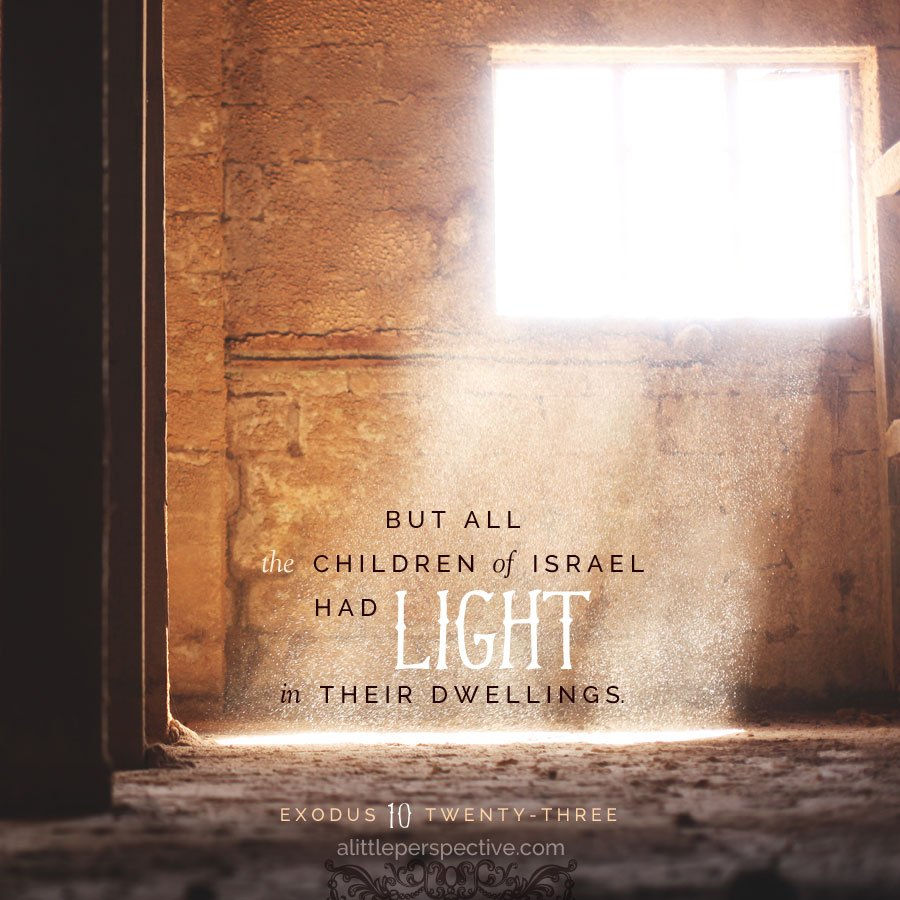
21 Then the LORD said to Moses, “Stretch out your hand toward the sky so that darkness spreads over Egypt—darkness that can be felt.” 22 So Moses stretched out his hand toward the sky, and total darkness covered all Egypt for three days. 23 No one could see anyone else or move about for three days. Yet all the Israelites had light in the places where they lived.
24 Then Pharaoh summoned Moses and said, “Go, worship the LORD. Even your women and children may go with you; only leave your flocks and herds behind.”
25 But Moses said, “You must allow us to have sacrifices and burnt offerings to present to the LORD our God. 26 Our livestock too must go with us; not a hoof is to be left behind. We have to use some of them in worshiping the LORD our God, and until we get there we will not know what we are to use to worship the LORD.”
27 But the LORD hardened Pharaoh’s heart, and he was not willing to let them go.
28 Pharaoh said to Moses, “Get out of my sight! Make sure you do not appear before me again! The day you see my face you will die.”
29 “Just as you say,” Moses replied. “I will never appear before you again.”
11 Now the LORD had said to Moses, “I will bring one more plague on Pharaoh and on Egypt. After that, he will let you go from here, and when he does, he will drive you out completely. 2 Tell the people that men and women alike are to ask their neighbors for articles of silver and gold.” 3 (The LORD made the Egyptians favorably disposed toward the people, and Moses himself was highly regarded in Egypt by Pharaoh’s officials and by the people.)
4 So Moses said, “This is what the LORD says: ‘About midnight I will go throughout Egypt. 5 Every firstborn son in Egypt will die, from the firstborn son of Pharaoh, who sits on the throne, to the firstborn son of the female slave, who is at her hand mill, and all the firstborn of the cattle as well. 6 There will be loud wailing throughout Egypt—worse than there has ever been or ever will be again. 7 But among the Israelites not a dog will bark at any person or animal.’ Then you will know that the LORD makes a distinction between Egypt and Israel. 8 All these officials of yours will come to me, bowing down before me and saying, ‘Go, you and all the people who follow you!’ After that I will leave.” Then Moses, hot with anger, left Pharaoh.
9 The LORD had said to Moses, “Pharaoh will refuse to listen to you—so that my wonders may be multiplied in Egypt.” 10 Moses and Aaron performed all these wonders before Pharaoh, but the LORD hardened Pharaoh’s heart, and he would not let the Israelites go out of his country.
Point 1, Article 1: God’s Right to Condemn All People
Since all people have sinned in Adam and have come under the sentence of the curse and eternal death, God would have done no one an injustice if it had been his will to leave the entire human race in sin and under the curse, and to condemn them on account of their sin. As the apostle says: “The whole world is liable to the condemnation of God” (Rom. 3:19), “All have sinned and are deprived of the glory of God” (Rom. 3:23), and “The wages of sin is death” (Rom. 6:23).
Summary
The ten plagues that God unleashed upon Egypt systematically attacked and humiliated their core religious presuppositions. The Nile river, Egypt's source of life and stability had been turned to blood. Gnats, flies and locusts not only devastated Egypt's economy, but they ironically demonstrated the Egyptians really had no control over an environment they thought they had dominated. Their livestock had died, boils beset them and hail crushed whatever was left.
Through it all, Pharoah's heart remained hard as stone. Certainly there were times that even he was so overcome that he almost gave in; at other times he tried to bargain with Moses, as we read today when he said the people could go, but their livestock needed to stay behind. Ultimately though, nine times in a row, even as everything that Pharoah had thought to be so strong had its true vapidness displayed, he responded by spitting in God's face.
And then the ninth plague came: total darkness covered Egypt for three days. Dark chaos reigned over a land who's highest power was Ra, supposedly the god of the sun. At this point everyone in the land except Pharoah - both the common people and Pharoah's officials - had a favorable disposition toward the Israelites, and Moses himself was highly regarded. They had seen the LORD's power and aligned themselves with it.
But not Pharoah. Even after nine humiliating displays of divine power that had crumbled his once proud nation in a matter of days, Pharoah refused to listen. Certainly the LORD hardened Pharaoh's heart, but nowhere does the text present him as an unwitting victim or pawn. God didn't create his rebellion; God simply hardened the rebellion that Pharoah had incubated on his own.
Dig Deeper
Total darkness covered all Egypt for three days. Well, not all Egypt. Whereas none of the Egyptians could see anyone else or move around, all the Israelites had light in the places where they lived. As the plagues escalated, God increasingly distinguished His covenant people from the rest of the sinful world that surrounded them. It's a distinction that will be made the clearest as we read of the Passover tomorrow.
This distinction is nothing new for us at this point; we've seen it over and over as we've read through the opening pages of the Bible this past month. The line of Seth was distinguished from that of Cain. Noah's family was distinguished from the rest of humanity and protected from the flood. Salvation comes only to Abraham's offspring (which we are in Christ). Ishmael was sent away so that Isaac would carry on the covenant. Jacob God loved, but Esau He hated.
God often provides blessings for all people - He provides people with plenty and even fills their hearts with joy (Acts 14:17). But God reserves salvation for His covenant people. Peter explains the significance of being included in God's covenant: You are a chosen people, a royal priesthood, a holy nation, God's special possession. Holy here means to be separated - literally, cut apart - from the rest of the world.
So as you work your way through this week, remember who you are. You are a covenant child of God. This inclusion results in an obligation, Peter says. You've been included in God's covenant so that you may declare the praises of Him who called you out of the darkness and into His wonderful light (1 Peter 2:9-10).
ACKNOWLEDGE WHO GOD IS: Our Father, who always remembers His covenant and rescues His people so we can see Him and know that He is the LORD our God;
ALIGN YOUR LIFE WITH GOD'S WILL: Pray that your life will demonstrate the distinctives that set you apart as God's covenant child;
ASK GOD FOR WHAT YOU NEED:


Comments